
Online Portal - Images sanitised for confidentiality
DIGITAL APPLICATION PORTAL
My role
I worked as a UX/UI design co-lead on a large-scale digital platform, working end-to-end across discovery, design, validation, and delivery and representing the UX discipline across cross-functional teams. This role involved close collaboration with business and technical stakeholders, translating complex requirements into clear, usable digital experiences while adhering to government legislation and maintaining consistency across the platform.
Description
The platform supports complex and secure application submission and management workflows designed to serve a range of users with differing needs and responsibilities.
This platform includes:
- Customer portal, facilitating task management, business and services record management, user management, and complex application submission and status monitoring
- Staff portal on Microsoft Dynamics 365 for backend application monitoring
- Public-facing record websites illustrating the regulatory data from successful application outcomes

The process

Discovery
As the content of this project was sensitive in nature, we were unable to complete interviews and workshops with applicant end-users during the discovery phase. We utilised empathetic modelling, online ethnographies, and co-design to define personas and high-level user needs with the client, allowing us to keep the end-user at the centre even with this constraint.
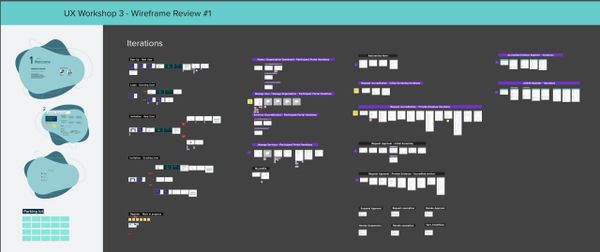
Workshops
I designed and facilitated a series of workshops to shape the product direction and validate assumptions with stakeholders as we progressed through the design. We validated our information architecture, low-fidelity and high-fidelity wireframes, and UI content continuously as we progressed throughout the project.
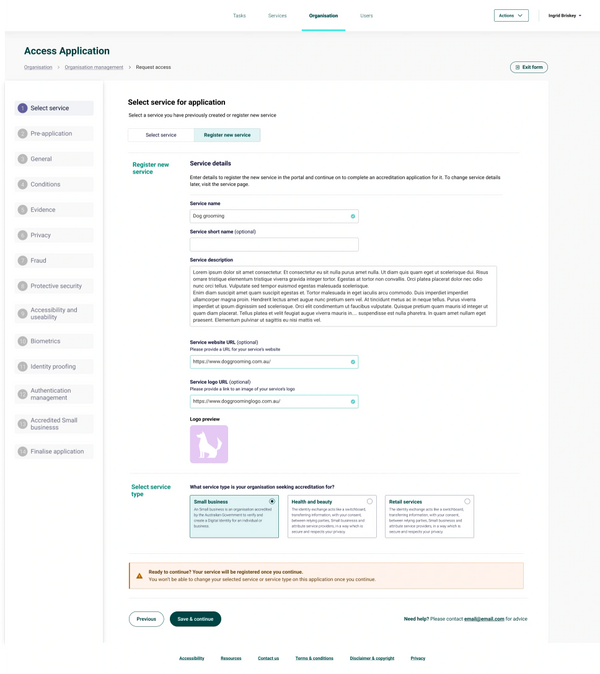
UI design
I led the design of complex interfaces across the platform, including:
- Multi-step application forms and submission flows
- Workflow and task management interfaces
- Microsoft Dynamics 365 backend management portal
This work required designing detailed form behaviours, the creation of a UI design library with scalable and reusable UI components and patterns, strong documentation of design choices and decisions, and interaction models supporting a wide range of scenarios and edge cases.
Design outputs included high-fidelity interfaces, reusable components, and detailed wireframes covering multiple states, conditions, and validation scenarios to support implementation.